If you are holding a shiny picture with a printed credit to F.J. Warren Ltd, Hitchin, you are holding a Dufex print. The two names are often used interchangeably by sellers — a listing might call it a "Dufex foil print", a "F.J. Warren metal picture" or simply an "old foil picture" — but they describe the same thing: a decorative print made by one English printing company using a process it developed itself.
The company behind Dufex
F.J. Warren Ltd was a printing firm based in Hitchin, Hertfordshire, in England. It developed the Dufex process early in the twentieth century and then refined and expanded it over the following decades. From the middle of the century onwards the range grew quickly and became a familiar sight in British homes, gift shops, seaside arcades and card shops, reaching its widest popularity in the 1950s through to the 1990s.
Because F.J. Warren printed, published and distributed the range themselves, Dufex is unusual among decorative prints in being traceable to a single source. That is very good news for anyone trying to identify a piece: the maker is rarely a mystery, and the range is documented well enough that subjects, formats and artists can usually be pinned down.
How the Dufex process works
Dufex is not a lithograph with a shiny finish sprayed on top. The metallic effect is built into the material and the printing sequence:
- Foil-lined board. The image is printed onto paper or board that has been laminated to aluminium foil, so a mirror surface sits directly beneath the inks.
- Transparent inks. The inks are formulated to stay translucent. The reflective foil reads through them, which is why the colours in a Dufex print seem to glow from behind rather than sit on the surface.
- Engraving. The printed sheet is then worked with engraving tools that cut fine textures and patterns into the foil. Each cut catches light at a different angle.
- Mounting. Finished prints were mounted onto board or into frames, often with a printed border and a label on the reverse.
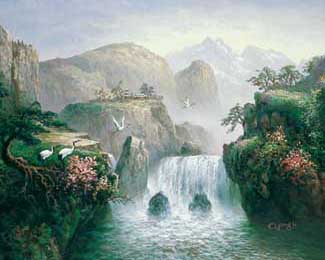
The result is the effect collectors describe as "moving": tilt a Dufex foil picture and highlights travel across water, sky, foliage or a ship's rigging. Flat photographs cannot capture it, which is why Dufex is one of the few print types that still has to be seen in the hand to be appreciated.
What F.J. Warren printed
Dufex was never only a wall picture. The same process ran across a whole product range, which is why collections turn up as a mixture of formats:
- Foil prints and foil pictures — the large framed pieces sold for the home, in sizes from small mounted prints up to substantial pictures.
- Dufex postcards — the metallic finish in postcard format, sold at tourist counters and post offices.
- Greeting cards — foil embossed cards for Christmas, birthdays and general occasions.
- Toppers, stickers and craft sheets — die-cut foil elements made for card-making, decoupage and other crafts, sold in packs to hobbyists and dealers.
The artists behind the prints
Dufex subjects were painted and drawn by a number of artists working for F.J. Warren. Three names come up again and again in dealer listings and collector conversations:
- Jean and Ron Henry — the best known of the Dufex artists, and the pair most associated with the fantasy and fairy-tale range. Their shimmering woodland, fairy and storybook scenes are the pieces collectors ask for by name.
- Charles M. Russell — Western scenes, including cowboy and horse subjects, adapted for the foil process.
- F. Osborne — wildlife, particularly birds; duck and wildfowl subjects in flight are commonly attributed to this name.
Alongside these, a large number of subjects were produced by staff illustrators whose names never appeared on the print. A Dufex picture without an artist credit is completely normal and says nothing about its quality.
How to identify a Dufex foil print
Several characteristics together will confirm it. No single test is conclusive on its own:
- The surface. Look across it at a low angle in daylight. A Dufex print has a mirror-bright metallic ground with a fine, almost mechanical texture engraved into it. Ordinary foil-embossed cards are plastic-shiny and flat by comparison.
- The edge. Many prints show the foil layer at the cut edge of the board, or a slight metallic line under the mount.
- The credit. Look in the border of the image and on the back of the mount or frame for "F.J. Warren Ltd", "Hitchin", "Dufex" or a printed label.
- The subject and style. The palette, the engraved highlight patterns and the subject range — wildlife, cottages, ships, fantasy, religious, children's themes — are characteristic once you have seen a few.
- The mount. Original Dufex mounts and frames are often distinctive, though these are the parts most likely to have been replaced over the years.
What affects the value
Prices for Dufex prints range from a few pounds for a common unframed subject to well over a hundred for a large, framed piece by a sought-after artist in excellent condition. The variables that matter most, in order:
- Artist and subject — Jean and Ron Henry fantasy scenes lead the market, followed by the more dramatic wildlife and maritime subjects.
- Size — large prints consistently outperform small ones.
- Condition — foil is easily scratched, creased or dented, and damage is very hard to reverse. Scratches in the metallic ground hit value hardest.
- Frame and mount — an original frame in good order adds real money; a cheap replacement frame does not.
- Completeness — full sets of postcards or cards, and unopened packs of toppers, are worth more than the same items loose.
Have F.J. Warren Dufex prints to sell?
We buy Dufex foil prints, foil pictures, postcards, greeting cards and toppers worldwide, in any quantity. Email a few photos and we will tell you what they are worth and make a free, no-obligation offer — and we pay for the shipping.
Email photos for an offer Use Gmail instead
Main inbox: DUFEX@qq.com ·
Backup: dufexchina@gmail.com
If you do not hear back within 48 hours, please write to the Gmail address — QQ Mail sometimes
filters first messages from overseas into spam.